You have just finished a shower, and are putting some moisturiser on your skin. Then you observe something new on the back of your hand. You see a flat sort of lump almost a sore (although it doesn’t necessarily hurt) with a scaly crust. You give it an extra dollop of goop, hoping that will do the trick.
I mean, you’re only in your forties and generally pretty healthy. In fact, you could even be quite sporty, enjoying outdoor walks and trips to the beach, maybe a bit of golf, swimming, hard core gardening on the weekend. But, you mostly take precautions, like sunblock and a hat, sort of, well at least when you remember. You’re sure it will be fine.
Two weeks pass though and that thing is still there – despite the copious amounts of moisturiser you’ve been using on it. You decide that maybe it’s time to consult your doctor. He or she takes a sample from your skin and sends it to the laboratory.
Then they tell you that you have squamous cell carcinoma, a non-melanoma type of skin cancer. Oh my goodness, you have skin cancer!
First things first, don’t panic. Squamous cell carcinoma is the second most frequently diagnosed skin cancer (making up around 30% of non-melanoma skin cancer) after BCCs and they’re easily treated as long as you don’t just leave it. That’s why, if after a couple of weeks, your lump, spot, scaly bit isn’t getting better, it’s best to get it checked by a skin cancer Dr.
What can squamous cell carcinoma look like?
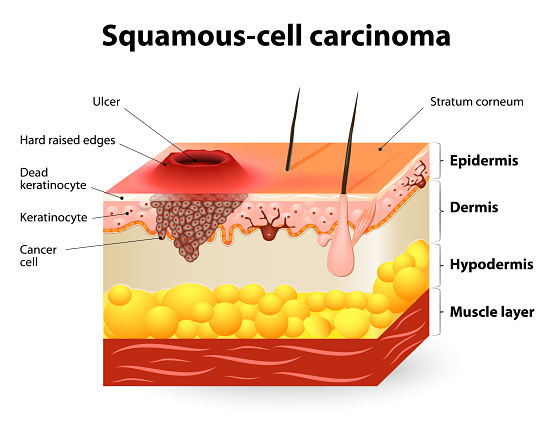
Squamous-cell carcinoma or squamous cell cancer.
Well, like other types of skin cancer it can vary. So it could have the following appearances;
- A solid, red node grows on your skin.
- An irregular, flaking area on your lip, ear, scalp (especially for balding men) and may gradually develop into an open sore that just doesn’t heal
- A red sore or coarse area inside your mouth
- A red, raised patch or sore on or in the anus or genitals,
- A flat sore with a scaly crust
- A new sore or raised area on an old scar or ulcer.
These sores tend to occur in the most sun-exposed areas of your body, such as your scalp, ears, lips, and back of the hand. But it can also occur other places on your body, including inside your mouth, anus, and genitals.
Squamous Cells and Your Skin
Squamous cells are one of three cells that cover the first two layers of the skin: the epidermis, and the dermis. The epidermis is the top layer of the skin, comprised of cells that eventually slough off. Below the epidermis (which has four layers) is the dermis, which has a living basal layer of cells. This is where you have hair roots, sweat glands, nerves, lymph, blood vessels and nerves. Before a skin cancer can spread, it must first move into the dermis.
Squamous cell carcinoma (SCC) is characterised by uncontrolled growth of abnormal cells in the squamous cells. They are not pretty, and sometimes they bleed. If untreated, they can spread to other organs within the body. Although this is unlikely, it is possible.
What causes Squamous Cell Carcinoma?
The main cause of SCC is cumulative ultraviolet (UV) exposure over your lifetime, especially if you expose your skin to the sun’s UV rays daily – especially in the hottest times of day between 10am-4pm (remember those walks on the beach!!). You must always make sure that you’re protected with sunblock, long sleeves and a hat when you go out.
Squamous cancer can occur even on areas of the skin that aren’t exposed to the sun, including the genital areas – any part of the body where squamous cells are, which happen to be everywhere. Ordinarily, new cells push older cells toward your skin’s surface, and the older cells die and are sloughed off. DNA errors disrupt this orderly pattern, causing cells to grow out of control, resulting in squamous cell carcinoma of the skin.
Most DNA skin cells are damaged by UV radiation from the sun. But this doesn’t explain skin cancers that develop on skin that isn’t usually exposed to sunlight, indicating other factors that may be SCC risks, for example, exposure to toxic substances, or having a weakened immune system.
Who is most at risk of Squamous Cell Carcinoma?
Some people are more at risk than others, for example:
- Fair skinned people. Anyone can get SCC but fair skinned people have less melanin, a protective skin pigment.
- People who are blonde, or red haired, with light-coloured (blue, green or grey) eyes, freckles or those who burn easily.
- People with a history of sunburns, who had one or more blistering sunburns as a child or teenager, are at greater risk of developing SCC as an adult.
- Sunburns in adulthood.
- A personal history of precancerous skin lesions such as actinic keratosis or Bowen’s disease.
- A personal history of skin cancer. If you’ve had SCC once, it is more likely to recur.
- Weakened immune system. Especially those with leukaemia or lymphoma, who take medications that can suppress the immune system.
- Rare genetic disorder. People with xeroderma pigmentosum (a rare, hereditary disease where patients have skin hypersensitivity to sunlight), greatly increases risk of developing SCC.
What about treating Squamous Cell Carcinoma?
The good news is, there are so many ways to treat SCC successfully if you catch it early. Treatments include laser therapy, freezing, Imiquimod cream or a simple excision.
For more serious conditions, a specialist might use Mohs surgery – where the doctor removes the cancer layer by layer until entire cancer is removed. Or for deeper tumours, your doctor might use radiation therapy.
What are the survival rates for Squamous Cell Carcinoma?
They’re really high. The five-year cure rate is 97.4%, so the chance of a truly awful outcome is very low. BUT only if treated and treated early.
That having been said, not all scaly skin conditions are cancer. It could be a myriad of other, non-cancerous, skin conditions. However, if you have something that you’re just not sure about on your skin, best get it checked out by a reputable skin cancer Dr as a first port of call.
If anything above resonated with you or you use to be a sun worshipper, you might consider getting yourself a skin cancer checkup. We’d be delighted to assist you. You can book your appointment by calling us on 999 0336 (Northern Beaches) or 9223 1608 (Sydney CBD), or by dropping us a note via the form below and we’ll be in touch.
Don't delay. Book your appointment today.
Call and book on 9999 0336 (Northern Beaches) or 9223 1608 (Sydney City) or drop us your best contact number or email address and we'll get in touch with you.
Either way, it might be the best thing you do for yourself today.