As part of our ongoing series on the different types of skin cancer, this week we take a closer look at Melanoma.
Australia has the second highest melanoma prevalence rate in the world. Must be something to do with our sun, sea, sand or ‘on the land’ culture and our wonderful climate.
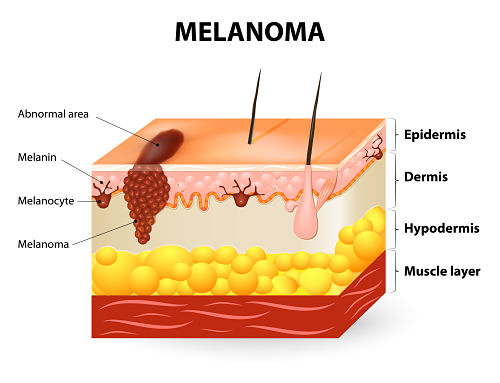
Melanoma or skin cancer. This type of skin cancer originates from melanocytes layers of the human skin.
What is melanoma?
Melanoma is a type of skin cancer. It is a type of malignant tumour, that can appear anywhere on the body. Melanoma begins in your skin’s pigment cells (melanocytes) – the cells that produce the pigment melanin that colour your skin, hair and eyes and that also helps to protect the skin from UV radiation – but only to a point.
As melanocytes group together during childhood or adolescence, they form a mole or a freckle. Most moles/freckles aren’t harmful. But if the melanocytes in a mole/freckle grow and divide uncontrollably, by either expanding outwards on the skin surface and/or going down into the lower layers of the skin, they can become a melanoma.
Of all skin cancers, melanoma is the most dangerous. It grows very quickly if left untreated, spreads below your dermis, and can enter the lymphatic system. Upon metastasis, it goes into the bloodstream, liver, lungs, bone, or brain.
What causes melanoma?
It is not clear what causes all melanomas, but definitely, limiting your exposure to the sun will reduce the risk of its incidence.
Melanoma is linked to infrequent but excessive sun exposure – often the type that causes sunburns – even if you only get burnt a handful of times in your lifetime. The sunburn may have occurred during childhood, but it doubles the risk of experiencing melanoma later in life.
Other risks are family history, having fair-skin (due to lower presence of protective melanin), being a blue-eyed blonde, redhead, or having albinism. Others with freckles or moles have a slightly higher than normal risk too.
That’s not to say, if your skin is naturally olive or you have African, Aboriginal or Islander heritage that you’re safe. See our previous blog on Skin Cancer Myths Debunked.
To protect yourself from melanoma, use sunblock that prevents skin cancer. Also, simple habits like wearing sun-protective clothes are helpful. Have a skin exam annually. The earlier a melanoma is identified, the easier it is to treat.
How do I know if I have melanoma?
Look for signs such as a spot on your skin that seems to be new, or is changing. True, everybody gets skin spots and with age, they become more plentiful and differ. Most often, the spots are not cancerous, nor are they about to become cancerous. They’ll be largely benign.
Examples of these are freckles, cherry angiomas, raised, seborrheic keratosis, irregular bumps on the skin, benign moles, and angiomas. But as soon as you see a new spot, or a spot that has changed on your skin, schedule a skin check immediately.
What does melanoma look like?
Melanomas are usually flat, uneven and streaked. They are mottled and often, multicoloured – brown, black, blue, red, pink, grey, or even skin coloured. They can be very dangerous, because in six weeks, if untreated, can spread to other parts of your body.
The physical characteristics of melanoma follow the ABCDEFG formula:
- A – asymmetry. Generally melanomas aren’t round, they are asymmetrical
- B – border – melanoma’s borders are uneven
- C –colour. Generally the colour of a melanoma is unusual or uneven in hue
- D – diameter, i.e., melanomas are generally larger than 7 mm (but not always)
- E – elevated – they often feel raised to the touch
- F – firm – they often feel firmer than surrounding skin to touch (but not always – especially in the early days)
- G – growing – Melanomas have a propensity to grow more quickly than other spots, lumps and bumps.
Nodular Melanoma is a highly perilous type of melanoma. Its appearance differs from the usual melanomas. From the start, it is raised and the colour is even, whether it is red, pink, and less often, brown or black. This melanoma grows very quickly and can be life threatening if it is not immediately detected and removed.
What warning signs should I look for to know that I might have melanoma?
Take note of new moles or growths, especially if they are changing. Also, look for lesions that itch, bleed, change, and don’t heal. A mole may be harmless, but then again, it is still risky. This is why you should check your skin regularly and book an annual skin cancer checkup.
When should I consult a doctor?
As soon as you notice a spot on your skin that wasn’t there before or you notice something changing, consult your skin cancer clinic doctor. Your mole or spot may be harmless, but it’s always better to be safe than sorry.
If you’re worried about a spot on your skin or you used to be a sun worshipper, you should consider getting a skin cancer checkup. And of course, we’d be delighted to assist you. You can book your appointment by calling us on 999 0336 (Northern Beaches) or 9223 1608 (Sydney CBD), or by dropping us a note via the form below and we’ll be in touch.
Don't delay. Book your appointment today.
Call and book on 9999 0336 (Northern Beaches) or 9223 1608 (Sydney City) or drop us your best contact number or email address and we'll get in touch with you.
Either way, it might be the best thing you do for yourself today.